
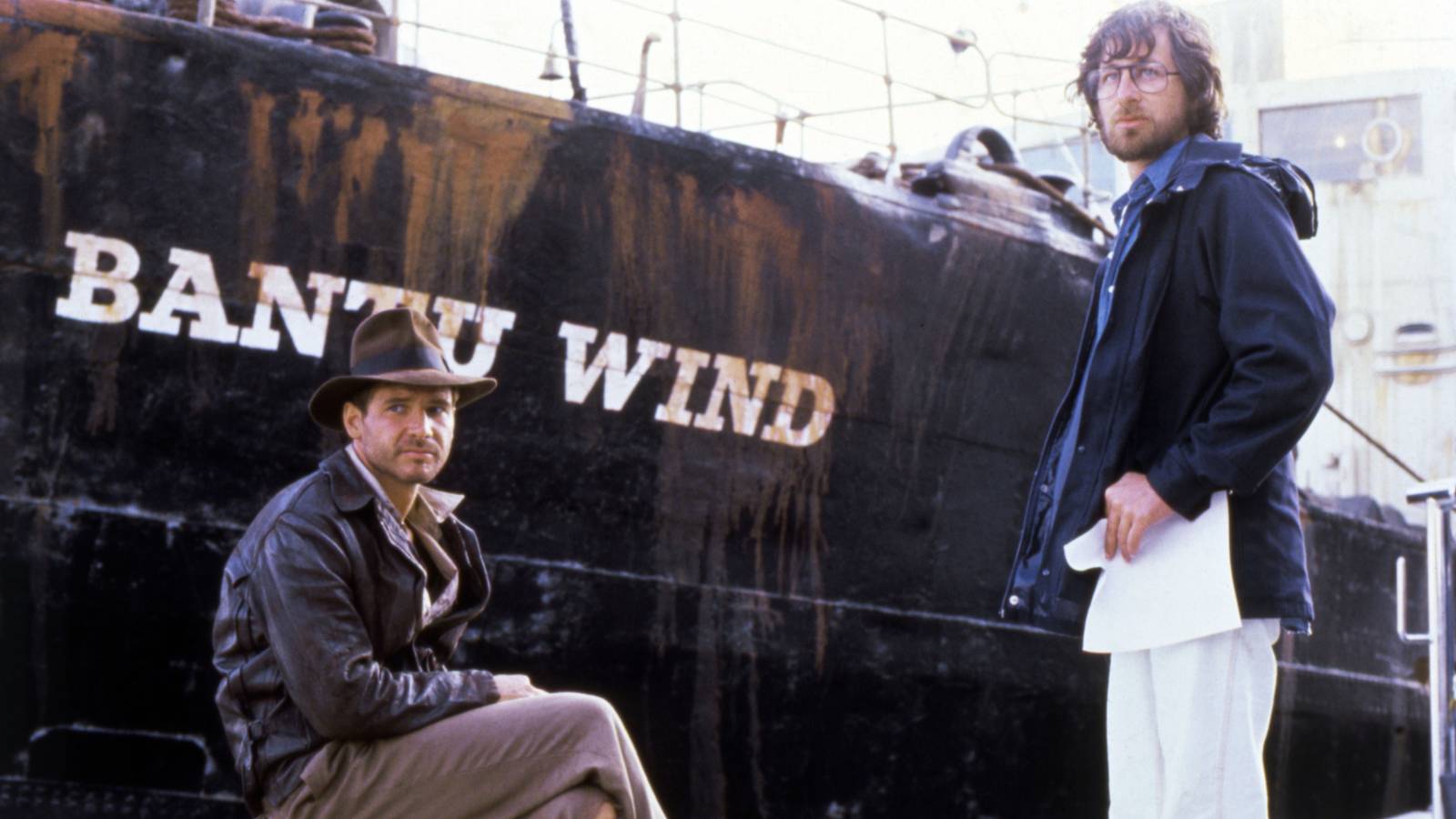
Few directors have had as strong and sweeping an influence on the film industry as Steven Spielberg. The born filmmaker began producing amateur movies in his adolescence before formally studying film at California State University, Long Beach. His original short film, AMBLIN, earned the film student a seven-year-contract with Universal Television. Spielberg ran with the offer and left school a year before graduating (via Amblin Entertainment).
After directing several shows and made-for-TV movies, Spielberg had his theatrical feature film debut in 1974. The Sugarland Express was a hit among critics and established Spielberg as an up-and-coming Hollywood Great. A year later, Jaws splashed into theaters and changed both the young director’s career and the nature of moviemaking as a whole. Since then, Spielberg’s films have had a habit of amassing a fortune at the box office and shaping American culture, including Close Encounters of the Third Kind (1977), Indiana Jones (1981), E.T. the Extra-Terrestrial (1982), Jurassic Park (1993), and so on.
Since his theatrical debut, Spielberg has directed over 30 films as well as shorts, TV shows, and video games. Audiences may be aware of the filmmaker’s general influence—and a few key accomplishments—but few realize the degree to which Spielberg has changed the film industry over the past 50-plus years.
He Introduced the Summer Blockbuster

In 1975, Spielberg made a film adaptation of Peter Benchley’s killer-shark novel, Jaws. Produced on a sub-$12 million budget, Universal Studios spent nearly $2 million on the film’s advertising. The robust campaign pushed the original novel and used marketing partnerships to increase familiarity with the film (via IndieWire).
When Jaws released in June, audiences rushed to theaters for a reliably thrilling experience. Jaws grossed $261.3 million at the worldwide box office during its original release, making it the first summer blockbuster. The film went on to make $490.7 million across all releases.
Spielberg’s thriller indelibly changed film promotion and distribution. Hollywood has since focused on IP and guerrilla marketing to increase familiarity with a film before its release—turning movies into brands. Further, studios hold their most profitable flicks for the warmer months to create a summer blockbuster in the vein of Jaws. Summer movie ticket sales now account for about 40% of annual box office earnings in the United States.
He Helped Pioneer CGI Effects

Spielberg’s 1993 film adaptation of the novel Jurassic Park changed the trajectory of cinema by pioneering early computer-generated imagery (CGI).
After practical effects technicians created an appropriately stunning stop-motion dinosaur, Spielberg decided to push this terror to the next level. Industrial Light and Magic (ILM) joined the production to bring the prehistoric monsters to life using CGI, in collaboration with existing practical effects technicians. The result was a never-before-seen, astoundingly life-like image of a dinosaur tearing through the screen among the live-action.
Ultimately, only about six minutes of the dinosaurs in Jurassic Park were completely CGI. Despite its minimal screen time, the CGI dinosaur sparked a revolution in computer-generated visual effects that would shape digital-age filmmaking. Photorealistic figures began to spring up in cinema and are now a fixture in modern films.
He Inspired the PG-13 Rating

The original Motion Picture Association of America (MPAA) ratings were G, M, R, and X. Eventually, M changed to PG (parental guidance). While today a PG rating denotes a kids’ movie, it initially indicated that a film contained mature material but was not age-restricted.
In the summer of 1984, two PG Spielberg movies highlighted the ambiguous gap between PG and R films. Gremlins and Indiana Jones and the Temple of Doom were deemed too graphic for the kid-friendly rating by parents of the time. Spielberg agreed, but did not feel either film deserved an R. This rating would restrict teens—the target demographic—from seeing the films in theaters.
To address the greater problem, Spielberg called the president of the Motion Picture Association of America at the time, Jack Valenti, and proposed a new rating. Spielberg recalled the conversation during a 2008 MPA video about the rating system.
“I said, ‘Let’s get a rating somewhere in-between PG and R,’” Spielberg recounted. “Jack was proactive about it, completely agreed, and before I knew it, there was a PG-13 rating.” Before the summer of ’84 was over, the first PG-13 movie arrived in theaters.
He Influenced Suspense-Based Horror

Spielberg’s 1975 blockbuster is primarily lauded for its influence on film promotion and distribution. However, Jaws also popularized suspense-based horror, now a fixture of the genre.
Initial Jaws viewers sat on the edge of their seats waiting for the gargantuan killer shark that the film advertised. They witnessed devastation and bloodshed, but the creature responsible remained under the cover of water until over an hour into the film. With Jaws, Spielberg demonstrated the power of allowing audiences to conjure their own terror. In doing so, he set the blueprint for slow-burn horror.
Before, movies referred to as “creature features” put their titular horror at the forefront. Following the success of Spielberg’s thriller, filmmakers kept their killers under wraps. Three years after Jaws, Halloween hid Michael Myers behind POV shots. Flashing forward five decades, 2026’s Backrooms extended suspense-based horror to its furthest point.
He Helped Propel Modern Animation

Though best known for his live-action blockbusters, Spielberg has been a longtime admirer of animation.
He produced his first animated feature, An American Tail, in 1986. The film became the highest-grossing non-Disney animated feature of the time and inspired Spielberg to explore animation further (via AFI). In 1994, Spielberg partnered with David Geffen and former Walt Disney Company chair Jeffrey Katzenberg to found DreamWorks SKG. The young company disrupted the complacent animation scene and offered animated features that could appeal to adult audiences.
Antz (1998) and The Prince of Egypt (1998) were the company’s first ventures. While neither outperformed Disney, they received enough attention to shake the market. The company’s biggest franchise, Shrek, became some of the highest-grossing non-Disney animated movies of all time. This Disney satire helped popularize comedy-first animation, a common feature of DreamWorks films.
Overall, Spielberg’s DreamWorks has influenced and expanded modern animation.
He Popularized Movies as Spectacle

Spielberg’s blockbusters transitioned from star-studded narrative dramas of earlier cinema to action-packed spectacles. His popular flicks utilized complex stunts and effects to create on-screen wonder. The larger-than-life concepts in his films were contrasted against everyday life to highlight the spectacle. Stunned characters gaped at a massive killer shark, inexplicable living dinosaurs, or an ominous flying saucer.
Audiences rushed to theaters to witness the on-screen spectacle and shared in the characters’ awe. Spielberg initiated modern ‘see it to believe it’ cinema, which has since pushed filmmakers to new heights of marvel. He also influenced movies as movies, distinct from the realistic Cinéma vérité style. Spielberg blockbusters are aware of and delight in their own artifice, utilizing technology to create movie magic.
Today’s high-concept box office tent poles are a direct consequence of Steven Spielberg’s mighty influence.