
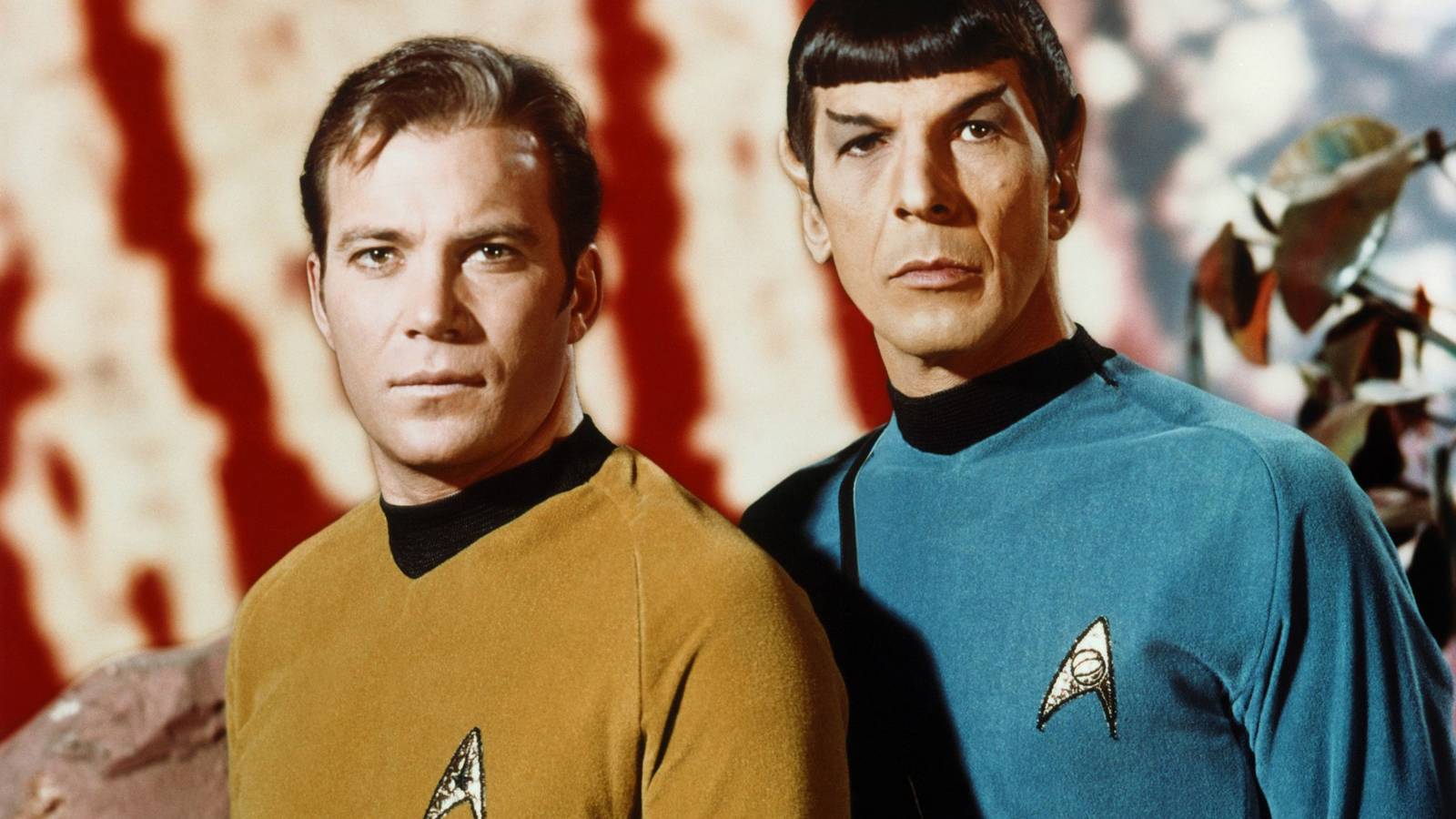
Star Trek has rightfully cemented its place as one of the best space operas of all time. While the crew of the USS Enterprise, led by Captain James T. Kirk, made exploring the universe an immersive adventure, the science fiction genre was already establishing itself long before then. When Star Trek debuted in 1966, it built on a foundation earlier sci-fi shows had already laid. The groundbreaking show took familiar genre concepts and transformed them into something that would leave an indelible mark on television.
These pre-Star Trek series show that though the genre has come a long way since the 1960s, science fiction has always explored deeply human questions through imagined worlds and characters. Unfortunately, not all the TV shows that came before Star Trek are discussed today, but their influence on science fiction, both then and now, is still apparent. Thankfully, some of these pre-Star Trek sci-fi shows have become cult classics, while others have been reimagined for a modern audience.
Voyage To The Bottom Of The Sea (1964-1968)

The mark of any good science fiction series lies in how well it holds up years later. Voyage to the Bottom of the Sea, fortunately, has the kind of story that even modern audiences can enjoy. Created by Irwin Allen, the show follows the crew of the Seaview, an experimental nuclear-powered submarine, as they explore the ocean.
Though the series included science fiction elements like aliens, Voyage to the Bottom of the Sea also explored other themes, including the anxieties surrounding the Cold War. For a show that debuted in the 1960s, Allen’s Voyage to the Bottom of the Sea was surprisingly ambitious and futuristic. Its four-season run and 110 episodes also helped establish science fiction as a sustained television format before Star Trek became one of the genre’s most recognizable franchises.
Men Into Space (1959-1960)

Starring William Lundigan as Colonel Edward McCauley, Men Into Space imagines a near future in which astronauts venture beyond Earth to explore the universe. Of course, hard sci-fi TV shows are now some of the most beloved series, but Men Into Space helped audiences see that the genre doesn’t need fantastical elements or out-of-this-world concepts to be relevant.
Like Apple TV’s For All Mankind, Men Into Space explores the early years of the Space Race. Although Men Into Space ran for onlyone season, the show’s influence lies in how it helped establish a more realistic approach to space exploration before Star Trek arrived. The series does not depict a future where humanity has already mastered interstellar travel. Instead, it draws its strength from depicting the difficult first steps needed to move such achievements from imagination to reality.
Tales Of Tomorrow (1951-1953)

One reason science fiction thrives is that it covers a myriad of topics that seem both possible and impossible. As an anthology series, Tales of Tomorrow could delve into different areas of sci-fi in each new episode. Of course, the anthology format is now common in the genre, with shows like Black Mirror and Love Death & Robots proving that this kind of storytelling will never go out of style.
Despite 1950s television’s technical limitations, Tales of Tomorrow explored concepts that remain popular throughout the genre. The series premiere, “Verdict from Space,” revolves around an ancient recording device linked to a potential alien invasion, while “The Crystal Egg” follows a professor who discovers that a mysterious object provides a window onto Mars.
The Quatermass Experiment (1953)

Broadcast by the BBC in 1953, The Quatermass Experiment centers on Professor Bernard Quatermass, a brilliant scientist overseeing Britain’s first manned space mission. When the spacecraft crash-lands back on Earth, only one of its three crew members, Victor Carroon, remains. However, Carroon’s return is far from a triumph: he has been infected by an alien organism, and the mysterious presence inside him threatens to endanger the entire human race.
The Quatermass Experiment debuted at a time when space exploration was the talk of the town. However, the series didn’t make going into space and finding other planets a simple adventure. It explores the possibility that what humanity might encounter in other universes could be a dangerous entity we are not in any way prepared to face. That itself created a source of horror that later became a template for TV shows that combined fear with alien-invasion stories.
The Outer Limits (1963-1965)

The Outer Limits is a science fiction anthology series that premiered in 1963, three years before Star Trek made its television debut. Like Tales of Tomorrow and The Twilight Zone, The Outer Limits tells a different story in each episode rather than following a permanent cast of characters. Its narratives ranged from encounters with extraterrestrial beings to experiments that unleash terrifying consequences.
The Outer Limits was revived in 1995.
The Outer Limits was very influential on Star Trek. In fact, some of the anthology series’ costumes, monsters, and actors, including Leonard Nimoy and William Shatner, appeared in Star Trek. The two shows were different, of course. While Star Trek was a space adventure, The Outer Limits explored the darker side of science fiction.
Lost In Space (1965-1968)

Most space adventures center on skilled crews working toward some sort of mission. Lost in Space is different in that it focuses on the Robinsons, a family trying to survive in an unfamiliar universe. Also created by Irwin Allen and based on Johann David Wyss’ novel The Swiss Family Robinson, the space opera series became an instant hit and ran for three seasons. The classic TV show also spawned a 1998 movie and a Netflix reboot series of the same name.
Lost in Space‘s influence on the genre cannot be overstated. When many other sci-fi offerings of the era were experimenting with futuristic technology and the possibilities of interstellar exploration, Lost in Space took a more personal approach by placing a family at the center of its story.
Doctor Who (1963-Present)

Doctor Who is one of the most famous science fiction TV shows of all time, and it’s easy to see why it became an enduring franchise. While sci-fi series in the 1960s had been venturing steadily into various subject matter, Doctor Who showed that time travel can be a fun, engaging way to tell stories. By traveling through time, the series offered an endless way to explore multiple settings and timelines rather than just one.
The Doctor himself became a legend and one of the most distinctive characters in TV history. Over the years, several actors have taken on the mantle of the Doctor, from Matt Smith to Ncuti Gatwa, each bringing something unique to the character. Even now, Doctor Who is considered a masterpiece, and it all began in 1963 when the unusual series proved that science fiction can stay on TV for decades if done right.
The Twilight Zone (1959-1964)

When The Twilight Zone arrived on the small screen in 1959, it immediately established itself as a different kind of science fiction anthology series. Blending sci-fi, horror, and fantasy, the show explores extraordinary situations involving time travel, alien encounters, and futuristic technology. Although the original series ran from 1959 to 1964, many of its central ideas remain strikingly relevant.

Rearrange the movies into the correct US release order.
Sign in to claim your place
on the leaderboard!
“Eye of the Beholder” examines a society in which physical appearance determines whether someone is considered acceptable, challenging the assumption that beauty has a universal definition. In fact, some of these concepts introduced in The Twilight Zone can be seen in shows like Black Mirror. While Star Trek and The Twilight Zone examined completely different ideas, their enduring appeal is what sets them apart from other sci-fi shows.

- Release Date
-
1966 – 1969-00-00
- Showrunner
-
Gene Roddenberry
- Directors
-
Marc Daniels, Joseph Pevney, Ralph Senensky, Vincent McEveety, Herb Wallerstein, Jud Taylor, Marvin J. Chomsky, David Alexander, Gerd Oswald, Herschel Daugherty, James Goldstone, Robert Butler, Anton Leader, Gene Nelson, Harvey Hart, Herbert Kenwith, James Komack, John Erman, John Newland, Joseph Sargent, Lawrence Dobkin, Leo Penn, Michael O’Herlihy, Murray Golden
- Writers
-
D.C. Fontana, Jerome Bixby, Arthur Heinemann, David Gerrold, Jerry Sohl, Oliver Crawford, Robert Bloch, David P. Harmon, Don Ingalls, Paul Schneider, Shimon Wincelberg, Steven W. Carabatsos, Theodore Sturgeon, Jean Lisette Aroeste, Art Wallace, Adrian Spies, Barry Trivers, Don Mankiewicz, Edward J. Lakso, Fredric Brown, George Clayton Johnson, George F. Slavin, Gilbert Ralston, Harlan Ellison